AI Partnership Proposal
The proposal sent to Jamie and Beth on October 8, 2026, and accepted on October 12 for three months.
What I Heard
Jamie
You want to stay a small team. It’s why you use AI in the first place.
- Time is the problem. You and Scott already build with Claude Code and Cowork. Your dashboards pull acquisition cost, conversion and churn into one place and post to Slack. You changed the launch hub whenever you needed to. You have more ideas than hours.
- Scott can’t build it all. He’s part-time and newer to this. If every idea waits for him, you said it could take a year, and by then AI will have moved on.
- Your voice runs the content. The team writes in your voice, and the skills that hold it live in your Claude account. They aren’t all backed up, and they go stale after a couple of months without updates.
- You want the team using AI past search, without the mess. You want them curious and able to make and fix small tools, without eleven people building apps with eleven versions of your messaging.
Beth
You’re the CEO with no assistant, and the chief of staff tool keeps stalling.
- Tool churn keeps resetting it. Buzz, then Grokbot, then whatever shipped this week. Every restart makes the old progress look silly.
- Your team isn’t connected to the sources. People uploaded their own copies of the messaging skills. Curriculum sits in OneDrive, marketing in Google Drive, projects in monday.com and conversations in Slack. Nobody’s AI sees all of it.
- You asked who does what. The answer is below.
What I See
Launches interrupt projects, tools keep changing, and nothing shared sits underneath. I’d fix the shared context first.
Each new tool starts from zero. It doesn’t know your voice, your curriculum, your launch calendar or what Beth promised on yesterday’s Zoom, so someone feeds it all again.
With the context in one shared place, a new model reads the same files, and your voice, curriculum and history are already there.
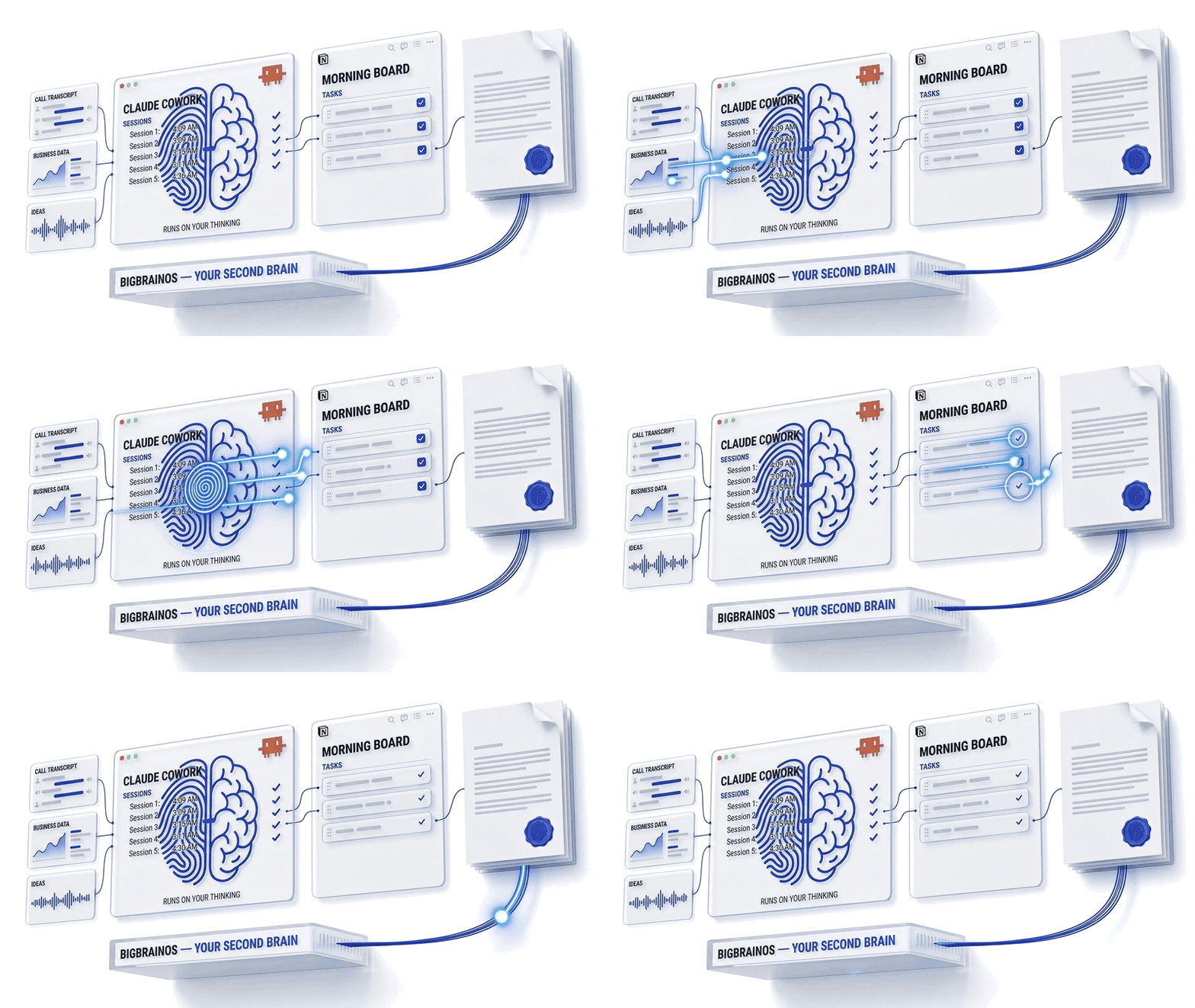
Obsidian works for one person and lives on that person’s computer. A team of eleven needs a shared place with permissions, so every Claude account on your Teams plan reads the same source. There are a few options we can explore, with Notion as one example.
How We Work Together
You choose one of three modes for each project.
| Mode | What I do | What you do | Good for |
|---|---|---|---|
| I build, you check | Build it, show you an early version, finish it, hand it over | Review the early version and the finished tool | Tools you need working but don’t need to shape |
| We shape it, I build | Brainstorm with you, ship a first version, iterate, train you on it | Bring the idea and react to each version | Tools you’ll use daily, like the chief of staff |
| You build, I support | Answer questions, unblock you, review your work | Build it | Small tools your team wants to own |
Every tool ends with a handover, a short walkthrough and a named owner on your team, usually Scott for anything technical. When something breaks, someone in-house knows where to look.
The First 30 Days
Suggested.
- Context plan. I map what lives in OneDrive, Google Drive, monday.com, Slack, Cloudflare and Claude Teams, decide with you what the shared brain holds, and connect every team member’s Claude to it. monday.com stays.
- Jamie’s skill pack. Your voice, messaging and marketing skills come out of your account, get backed up and get versioned. You update once and everyone has it.
- Beth’s chief of staff. A first working version on the shared context. If a better tool ships, I carry the context over and check the new version does the job. Mode: we shape it, I build.
- Bot library scoping. We pick the first three bots and start the catalog they read from: every resource with its grade, standards and description. Katie and Erin asked for a catalog like this, and Amanda’s tagging and refresh ideas and Nikki’s standards checker would use it too.
- Project board. All 30 ideas from your team’s list, grouped by what they need, prioritized with you two, with a status everyone sees.
The Project Hub
Every project with its status, owner and mode in one view, next to the shared context your AI reads. Open the demo hub.
This is just to track everything we are working on. I typically use Notion for this, but if you prefer keeping it somewhere else, happy to do that too.
If you decide to go with Notion for your full context layer, we would bundle it in. We could also probably merge monday.com into it if the team isn’t a big fan of the current setup.
The Retainer
$6,000 a month
Includes
- Builds from the board, one at a time, each with a handover and training
- Setting up the shared context and keeping it current
- Jamie’s skill pack, updated as models change
- A Slack channel with me for the whole team
- Office hours: anyone on the team can book 30 to 60 minutes to set up their Claude, connect sources or build something small
- A monthly team session on what’s new and worth using
Large builds, like a new app or the full bot library with paywall and checkout, get quoted separately before I start. Everything else we discussed fits inside this.
What You Can Count On
- You own everything. If we stop working together, everything I built stays with you, and each tool’s owner knows how it runs.
- Switch only when it helps. When something new ships, we test it against your shared context and switch only if it does the job better.
- Nobody has to code. I’ll connect each person’s Claude to the right sources and give them a short menu of skills. Claude Code stays with you and Scott.
- Fewer apps. You’ve been cutting apps. I’ll only add one that replaces something or earns its place.